Introduction
From 8–10 April, the PHAntastic project was represented at the Polymers 2026 Conference in Lisbon, Portugal – a key international event bringing together researchers, industry and policy actors working on sustainable polymer solutions.
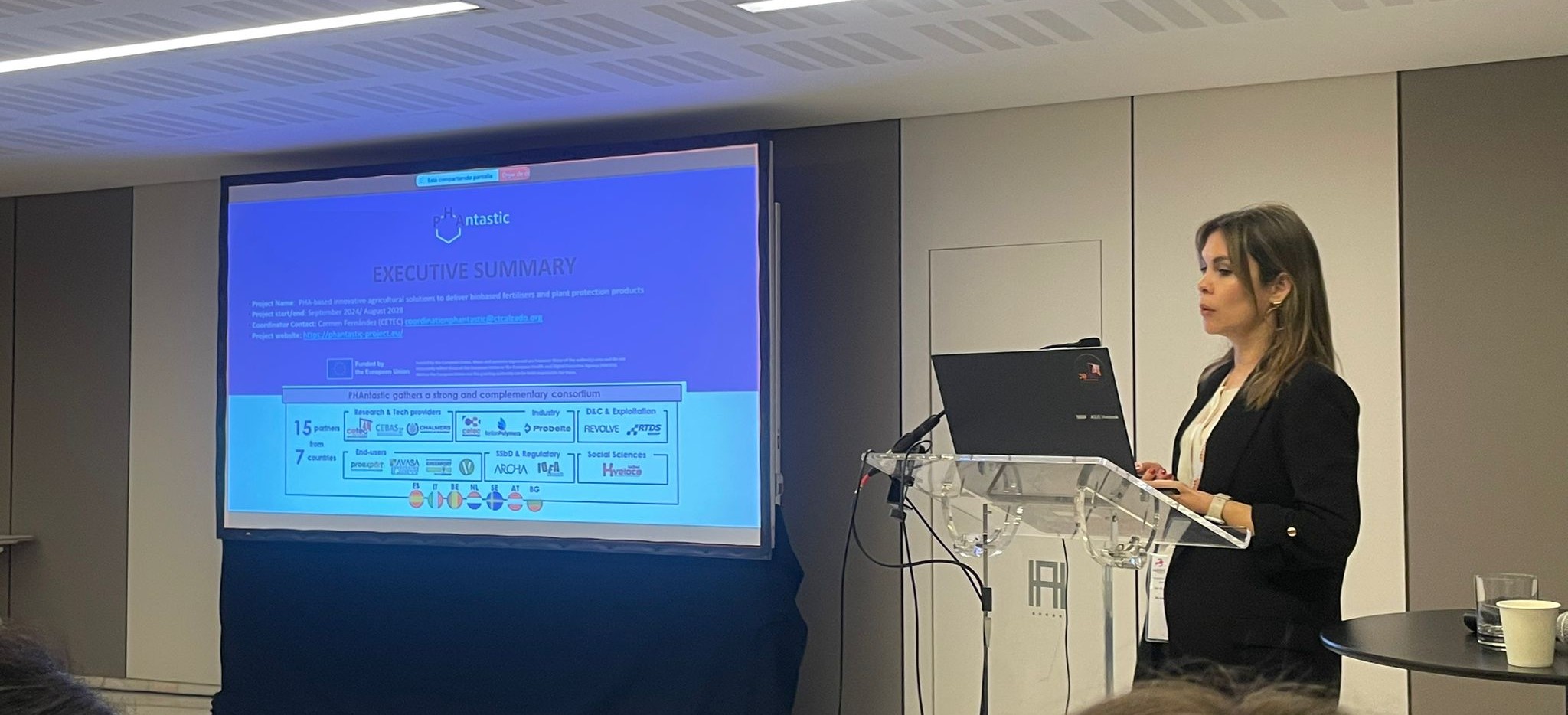
The CETEC team, coordinator of the project, hosted a joint workshop session, Safe and Sustainable Bio-Based Polymers: from Design to End-of-Life in Circular Value Chains. The workshop brought together leading European research projects, industry actors, and policy experts to address one of the most pressing challenges in the transition to a circular economy: the development and deployment of safe and sustainable bio-based polymers.
Across sessions, a common narrative emerged: while bio-based and biodegradable plastics hold significant promise as alternatives to fossil-based materials, their successful implementation requires a systemic approach. This includes material design aligned with end-of-life scenarios, integration of Safe and Sustainable by Design (SSbD) principles, robust assessment methodologies, and alignment with evolving EU policy frameworks.
The workshop highlighted the importance of connecting innovation across the value chain – from raw material sourcing and polymer synthesis to processing, application, and environmental fate – while ensuring that sustainability, safety, and circularity are embedded from the earliest stages of development.
Session 1 – European Innovation Landscape & SSbD Polymers
This session provided an overview of the current European innovation ecosystem in bio-based polymers, showcasing several Horizon Europe projects addressing packaging and agricultural applications.
The BIO4PACK cluster (ViSS, REBIOLUTION, MAGNO and STOPP) showcased solutions for sustainable packaging, focusing on replacing fossil-based plastics, improving recyclability and biodegradability, and integrating circularity and safety considerations from the design phase.
The agriculture-focused cluster (PHAntastic, ViNNY and BioVIVE) highlighted the development of biodegradable polymer-based solutions for agricultural applications, including mulch films, delivery systems for bioactive compounds, and alternatives to conventional agrochemicals, all aligned with SSbD principles and EU sustainability targets.
Finally, the ANIPH & MAGICBIOMAT cluster addressed challenges related to biodegradable materials in open and uncontrolled environments, promoting materials with controlled and safe biodegradation, supported by advanced testing methodologies and digital tools.
Key takeaways:
- Bio-based polymers are central to achieving EU circular economy and climate goals.
- Circularity must be designed from the outset, including feedstock selection and end-of-life pathways.
- Cross-project collaboration (clusters) is essential to maximise impact and avoid fragmentation.
- Agricultural and packaging sectors are key application areas with high innovation potential.
Session 2 – From Research Data to Sustainable Exploitation: Policy and IP Frameworks
This session focused on how research outputs can be effectively translated into societal and economic impact through strategic data management and policy engagement.
Speakers highlighted that research results are not only publications but also valuable assets such as datasets, models and digital tools. The challenge lies in balancing openness (Open Science requirements) with protection (IP and exploitation potential).
The importance of early-stage planning for data sharing and protection was emphasised, along with the need to align research outputs with policy priorities and stakeholder needs.
Key takeaways:
- Data management is a strategic tool for impact, not just a compliance requirement.
- Accessibility alone is insufficient—data must also be usable, interoperable and sustainable.
- Timing and strategy in data sharing are critical to maximise value and exploitation.
- Strong links between research projects and policy frameworks enhance long-term impact.
Session 3 – Safe and Sustainable-by-Design (SSbD): From Frameworks to Digital Tools
This session explored how SSbD principles are operationalised in practice, moving from conceptual frameworks to real implementation tools.
SSbD was presented as a holistic and preventive approach integrating safety, environmental, economic and social dimensions across the full life cycle of materials. Case studies (e.g. ViSS project) demonstrated how tools such as Life Cycle Assessment (LCA), Life Cycle Costing (LCC), and Social LCA can guide design decisions and enable iterative improvements.
The session also highlighted current gaps, particularly in social and economic assessment methodologies, and the need for practical, user-friendly tools to support decision-making.
Key takeaways:
- SSbD shifts innovation from reactive to preventive approaches.
- Lifecycle thinking is essential to identify environmental and social hotspots.
- Iterative design (design–assess–redesign) is key to achieving sustainability targets.
- Further development of social and economic assessment tools is needed.
Session 4 – Advanced Bio-Based Polymers: Processing, Scale-Up and Digitalisation
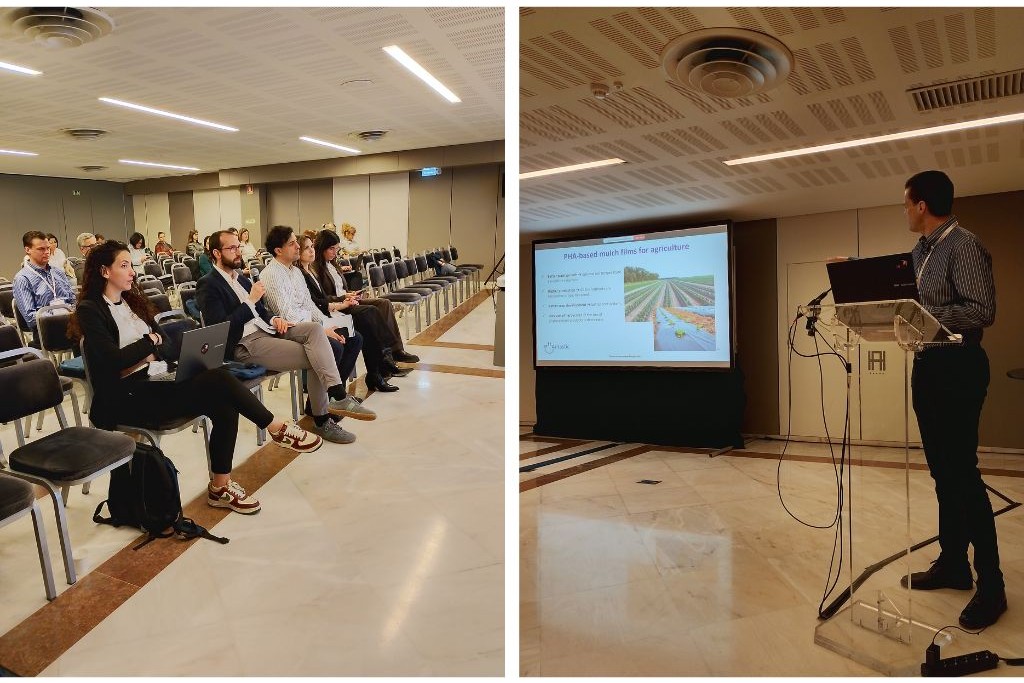
This session addressed the transition from laboratory research to industrial application, focusing on processing technologies, scale-up challenges, and digital tools.
Presentations showed advances in nanoencapsulation systems, polymer compounding, and digital twins for packaging systems (e.g. MAGNO project). These innovations enable better control over material properties, functionality and lifecycle performance.
A key message was that scalability and processability remain major challenges for bio-based polymers, requiring optimisation of materials, processes, and supply chains.
Key takeaways:
- Bridging the gap between lab-scale innovation and industrial deployment is critical.
- Digital tools (e.g. digital twins) enhance decision-making across the value chain.
- Processing and material performance remain key bottlenecks for bio-based polymers.
- Integration of functionality (e.g. controlled release, smart packaging) is a growing trend.
Session 5 – Biodegradation in Open Environments: Methods, Applications and Assessment
The final session focused on biodegradability as an end-of-life solution, particularly for applications where material recovery is not feasible.
Speakers highlighted that biodegradability must be carefully assessed under realistic environmental conditions, as performance varies significantly depending on the context (soil, marine, freshwater). Standardisation and harmonised testing methodologies were identified as critical needs.
Advanced approaches, including AI-based predictive models (e.g. ANIPH), demonstrated the potential to accelerate material development by predicting biodegradability, toxicity and performance.
Key takeaways:
- Biodegradability is a valuable solution for specific applications, not a universal answer.
- Environmental conditions strongly influence degradation behaviour.
- Standardised and comparable testing methods are essential.
- Digital and AI tools can significantly accelerate sustainable material design.
Overall Conclusions
The workshop clearly demonstrated that achieving safe and sustainable bio-based polymers requires a systemic, interdisciplinary and lifecycle-oriented approach.
Innovation must be supported by:
- Integrated frameworks such as SSbD
- Strong collaboration across projects and sectors
- Alignment with policy and regulatory developments
- Advanced tools for assessment, modelling and decision-making
These elements are essential to ensure that bio-based polymers can effectively contribute to Europe’s transition towards a circular, climate-neutral and pollution-free economy.