The transition towards more sustainable agricultural systems requires new materials that are not only effective during use but also aligned with circular economy principles from the very beginning of their production. In this context, the PHAntastic project is working on the development of bio-based and biodegradable agricultural solutions based on PHBV, a member of the polyhydroxyalkanoate (PHA) family.
PHBV is a biopolymer produced by microorganisms during fermentation. In PHAntastic, its production is closely linked to waste valorisation: instead of relying only on conventional raw materials, the process uses selected residues as valuable inputs. This approach gives a second life to waste streams and helps reduce dependence on fossil-based resources, supporting a more circular and sustainable model for agricultural plastics.
Waste pre-treatment: preparing nutrients for fermentation
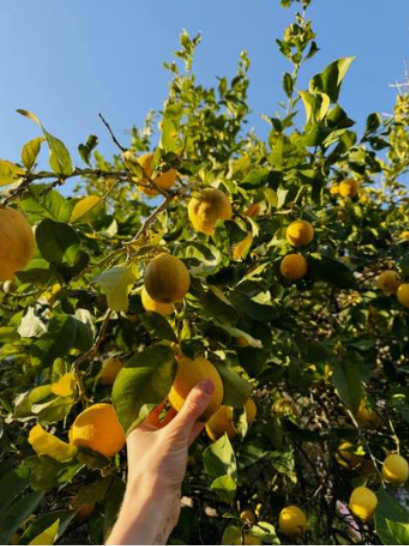
Hand Picking Ripe Lemons from Citrus Tree. Photo: JS / Pexels
One of the first steps in the process is the pretreatment of waste materials. In the project, lemon residues are used to obtain nutrients such as carbon, which are essential for microbial growth during fermentation. However, microorganisms cannot use these residues directly. They first need to be transformed into a liquid nutrient source.
To achieve this, an alkaline hydrolysis process is carried out. During this reaction, the organic material is broken down and the nutrients are transferred into the liquid phase. Once the reaction is complete, the mixture is filtered to remove the remaining solids. The liquid fraction, which contains the nutrients needed for fermentation, is then transferred to the bioreactor through a flexible pipe and mixed with the rest of the culture medium.
This step is essential because it connects waste valorisation with biopolymer production. Materials that would otherwise be discarded are converted into useful nutrients for microorganisms.
Upstream: fermentation at pilot scale
The production process is carried out in CETBIO pilot plant where the PHBV production is carried out through fermentation at a 300 L scale. The process begins in the laboratory, where the pre-inoculum grows until it reaches a volume of one litre. This pre-inoculum is then transferred to the pilot plant and used to inoculate a 40 L reactor.
This inoculum fermentation lasts 24 hours. After this period, the full volume is removed and divided into three portions, which are used to inoculate three selected 300 L reactors. Typically, two batches of three reactors are performed per week, depending on project needs and production planning.
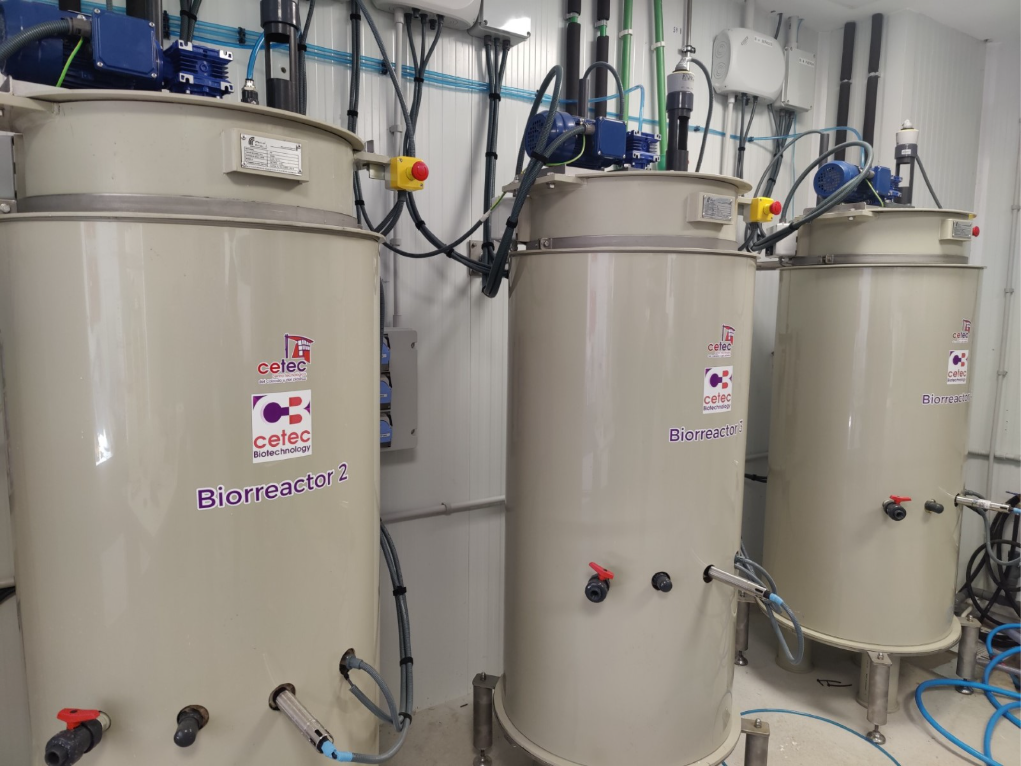
Bioreactors from CETBIO pilot plant
In the case of PHAntastic, the culture medium contains sugar-rich lemon residues from the agri-food industry. These residues provide a renewable carbon source for the microorganisms, while the nutrients obtained through pre-treatment support their growth and PHBV accumulation.
Downstream: recovering the microbial biomass
Once the fermentations reach the stationary phase, the process is stopped and the downstream stage begins. The objective of this step is to remove the water from the culture and recover the dry cell biomass that contains the PHBV.
The first stage of water removal is tangential flow filtration. In this process, the culture is filtered and washed to separate the biomass from the culture medium. After filtration, an evaporator is used to remove the remaining water. At the end of the downstream process, dry biomass is obtained, ready for PHBV extraction.
Extraction and purification of PHBV
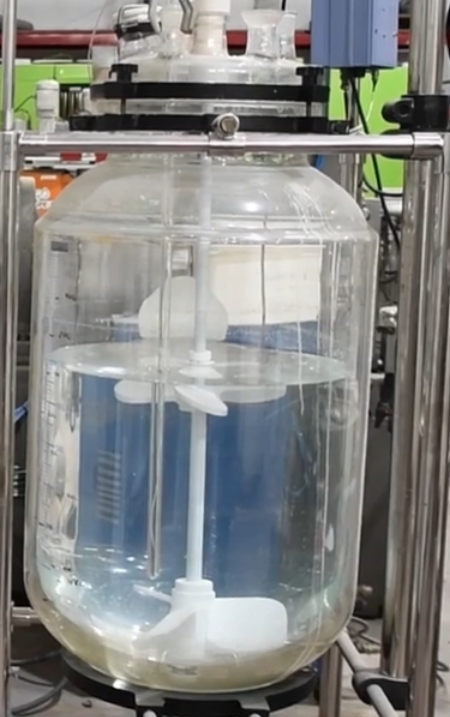
Reactor for the treatment of the raw material. Photo: CETEC
Once the biomass has been dried, the PHBV must be extracted from inside the cells. For this purpose, a solid-liquid extraction process is performed using green solvents in Soxhlet equipment.
The dried biomass is placed in a filter, while the solvent is added to the bottom flask. When the solvent reaches a temperature close to its boiling point, it evaporates and rises to the condenser. There, it cools down, condenses and falls onto the biomass, soaking it. The warm solvent extracts the PHBV from the biomass. When the solvent reaches the upper part of the system, it flows back into the bottom flask due to the siphon effect. This cycle is repeated for several hours until the PHBV has been extracted.
After extraction, the solvent is evaporated using a rotary evaporator so it can be recovered and reused in future extractions. The PHBV obtained is then purified by washing it with methanol and water to remove biomass residues and salts. Finally, the polymer is dried in an oven, weighed and stored.
Towards circular agricultural materials
The PHBV produced through this process will support the development of innovative agricultural systems within PHAntastic, such as biodegradable mulch films and growth foams. By combining lemon waste valorisation, nutrient recovery from other waste streams, pilot-scale fermentation and polymer extraction, the project demonstrates how biotechnology can contribute to more sustainable agricultural materials.
This approach shows that circularity can be integrated not only at the end of a product’s life, but also at the very start of its production.
Written by Cetec Biotechnology